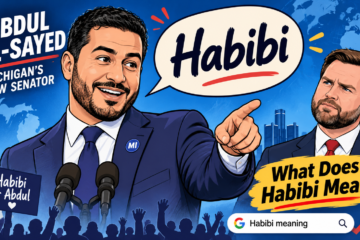
Quick answer: Abdul El-Sayed is widely identified as a Sunni Muslim. He is the son of Egyptian immigrants, and almost 90 percent of Egyptians are Sunni, while Shia Muslims make up less than one percent of the population. In public he simply calls himself a Muslim and a man of faith, and his sect has never been part of his political message. Al Jazeerathearda
Why is “Abdul El-Sayed Shia or Sunni” trending on Google?
The spike is easy to trace. Democrat Abdul El-Sayed defeated Republican Mike Rogers in Michigan’s closely watched Senate race, according to an Associated Press projection on November 4, 2026. He is the first Muslim ever elected to the US Senate, and he won by about seven points. Abdul El-Sayed defeats Mike Rogers in 2026 Michigan Senate election +2
A historic first like this sends millions of people to Google with one basic question: what kind of Muslim is he? The curiosity grew because New York City had elected Zohran Mamdani, the first Shia Muslim to hold the mayor’s office, only a year earlier. People who followed both stories wanted to know whether the two men share the same tradition. The question even reached AI chatbots on X, where a user asked point blank whether he belongs to the Shia sect or the Sunni sect. NBC Newsx
El-Sayed seemed to anticipate the curiosity. In his victory speech he proudly declared his full name, Abdulrahman Mohamed El-Sayed, a deliberate answer to a campaign that had turned his name and faith into attack lines. whsv
Who is Abdul El-Sayed?
It helps to know the man before answering the faith question. Abdulrahman Mohamed El-Sayed was born on October 31, 1984, in Rochester Hills, Michigan. His father, Mohamed El-Sayed, grew up in Alexandria, Egypt, and moved to the United States for graduate studies at Wayne State University. Abdul was later raised in the Detroit area by his father and stepmother, Jacqueline, a native of Gratiot County, Michigan. Wikipedia
His résumé is unusually long for someone who is 42. He studied at the University of Michigan, went to Oxford as a Rhodes Scholar, trained at Columbia, and later served as Detroit’s health director. He ran for governor in 2018 and lost to Gretchen Whitmer. In 2026, he beat Congresswoman Haley Stevens in the Democratic Senate primary, becoming the party’s nominee against Mike Rogers. cnkyinss
What Abdul El-Sayed says about his own faith
El-Sayed has never hidden his religion. In a 2019 podcast conversation with scholar Simran Jeet Singh, he described himself as a person of deep faith shaped by his Egyptian grandmother. He said he grew up in a devoutly Muslim household, rebelled against religion as a young person while keeping his faith, and later returned to practice on his own terms. Substack
During the Senate campaign he released an ad introducing himself as a man of faith and calling that a good thing. He has used the word inshallah in public speeches and told Religion News Service that faith pushes him to treat every person with dignity and respect. Imam Suleiman Hani of Farmington Hills, who has known him for years, describes him as a practicing Muslim with long roots in the Ann Arbor and Detroit area Muslim communities. Even his Rhodes Scholarship application credited his religion as a force behind his desire to study medicine. Abdul El-Sayed’s faith and family have come under intense scrutiny in Michigan race. Here’s what we know. +2
He met his wife, Sarah Jukaku, at the University of Michigan, where both were active in the Muslim Students’ Association, and he served on its board. At the same time, he has said he believes in the separation of church and state and wants an America where everyone can pray as they choose, or not pray at all. CBS Newsreligionnews
So, is Abdul El-Sayed Sunni or Shia?
Every available public source points the same way: Abdul El-Sayed is a Sunni Muslim. Three strands of evidence support this.
First, his heritage. He is the son of Egyptian immigrants, and Egypt is almost 90 percent Sunni, with Shia Muslims forming less than one percent of the population. A family from Alexandria is therefore overwhelmingly likely to be Sunni. Al Jazeerathearda
Second, independent analysts say so. A report from Israel’s Institute for National Security Studies noted his clear identification with the Sunni branch, while observing that Michigan’s Shia community still appears to have given him significant support. A separate analysis of America’s new Muslim progressives described Mamdani as a Twelver Shia and El-Sayed as Sunni. insscnky
Third, the campaign itself. Rogers accused El-Sayed of having ties to the Muslim Brotherhood, which NBC News describes as an international Sunni Islamist organization founded in Egypt in 1928. El-Sayed told Fox News he has never been a member of the Brotherhood and never will be. Voters rejected the accusation, but notice that even the attack assumed a Sunni background. NBC NewsCBS News
One honest caveat is worth stating. El-Sayed does not label himself by sect in speeches or interviews. He calls himself Muslim, full stop. That fits a wider American pattern. Pew Research found that 65 percent of US Muslims identify as Sunni, 11 percent as Shia, and about 15 percent describe themselves simply as Muslim with no specific affiliation. pewresearch
Why Michigan’s Shia community makes this question interesting
Michigan is not a typical state when it comes to Islam. Harvard’s Project on Shi’ism estimates Michigan’s Shia community at 200,000 residents or more, largely of Lebanese and Iraqi origin. Dearborn is home to the Islamic Center of America, the largest mosque in North America and the oldest Shia mosque in the United States. harvardicofa
So a Sunni candidate winning big in a region with an enormous Shia community is a story on its own. The INSS report argues that rising Muslim political activism may be bridging the Sunni and Shia divide, noting that Mamdani, a Shia, received wide support from New York’s mostly Sunni community, while El-Sayed mobilized broad backing from Michigan’s Shia community. Dearborn Mayor Abdullah Hammoud told the Associated Press that residents backed El-Sayed because of his policies and honest coalition building, not merely his ethnicity or religion. insswhsv
Does his sect change his politics?
Not according to him. He told the Associated Press, “I didn’t run to be the first Muslim senator,” explaining that he ran to be Michigan’s next senator who happens to be Muslim. His platform centered on universal health care, tackling medical debt, and higher taxes on billionaire wealth. whsvAxios
The win also followed a bruising campaign. President Trump called him a jihadist, language that critics denounced as Islamophobic. In his victory speech, El-Sayed spoke to parents who had struggled to explain why a president would mock someone for his name or the way he prays. For many Muslim Americans, the result felt larger than a single Senate seat. CBS NewsAl Jazeera
Frequently asked questions
Is Abdul El-Sayed Shia or Sunni?
He is widely reported to be a Sunni Muslim, consistent with his Egyptian family background. He personally describes himself as a Muslim without naming a sect.
Is Abdul El-Sayed a practicing Muslim?
Yes. He grew up in a devout household, returned to active practice as a young adult, and community leaders in Michigan describe him as a practicing Muslim.
Does he have ties to the Muslim Brotherhood?
He has flatly denied it, telling Fox News he has never been a member and never will be. CBS News
Why is he compared with Zohran Mamdani?
Both are progressive Democrats who won historic races a year apart. Mamdani is Shia and El-Sayed is Sunni, which is exactly why the comparison fuels searches.
Did Abdul El-Sayed win the 2026 Michigan Senate race?
Yes. He defeated former Representative Mike Rogers for the seat opened by the retirement of Senator Gary Peters. Time
When does he take office?
He is set to be sworn in on January 3, 2027, becoming the first Muslim US senator. britannica
Final word
The search phrase “Abdul El-Sayed Shia or Sunni” is really a question about who this new senator is. The evidence says Sunni, by heritage and by every analyst who has looked at the question. Yet El-Sayed’s own framing matters more: he asked Michigan to judge him on health care and the cost of living, and a majority of voters did exactly that.