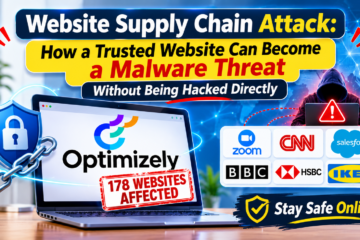
On November 16, 2026, anyone who opened Zoom, CNN, Salesforce or 175 other organizations’ websites could have loaded malicious code without clicking a thing. The Optimizely malware attack, found by security researcher Scott Helme of Report URI, ran through an A/B testing tool that big brands load on their pages. Report URI notes a site can be hit this way without its own infrastructure ever being breached, which is what makes this cyberattack on 178 websites hard to spot. Helme checked 1,611 Optimizely scripts and found 188 infected, belonging to 178 organizations.
If you visited one of those sites that day, three things matter: your iPhone’s iOS version, any crypto address you pasted, and your card statement. Optimizely says it has closed the hole.
How the Optimizely malware attack worked
Optimizely Web makes each customer load one JavaScript file from Optimizely’s servers. Inside it sits an optional field called Project JavaScript, where customers add their own code to run on every page, Report URI explains.
The attacker wrote a short loader into that field on many unrelated customers’ projects. It fetched a second script, track.js, from a domain called 1688360.cc.
The file still came from cdn.optimizely.com with Optimizely’s certificate, so every affected site already trusted the host. That’s the logic of a website supply chain attack: the site doesn’t need a flaw of its own when a vendor’s file does the dirty work.
Optimizely told BleepingComputer that an unauthorized party exploited a vulnerability in its Experimentation account signup flow and used it to add JavaScript to some customer projects. The company says it blocked the vulnerable path, shipped a fix, removed the injected code, ended active sessions, revoked tokens and reset access for affected accounts. It’s still investigating and posts updates at status.optimizely.com. I couldn’t find a CVE number for this Optimizely security vulnerability in any report published by November 17.
Who got hit
Report URI’s list spans banking and finance (32 organizations), technology (23), retail (20), streaming (12) and news and media (10). Names include the BBC, CNN, Fox News, IKEA, HSBC in several countries, Equifax, Air France-KLM, Ledger, Peacock and GitLab.
The Zoom malware attack in 2026 comes down to one modified file. Zoom’s Optimizely snippet carries a Last-Modified time of 11:20 UTC on November 16, according to Report URI’s timeline. FourWeekMBA’s summary of Reuters reporting says Zoom, HSBC, Equifax, CNN and IKEA hadn’t immediately answered requests for comment, and that Salesforce disabled the unauthorized script changes as a precaution.
Being on the list means a site’s Optimizely script was infected. It doesn’t mean the company’s own servers were breached, as Cyber Kendra points out. The 178 count also looks low: Helme could only check scripts he managed to find.
What the malicious JavaScript attack could steal
Every visitor to an infected page got the same track.js, with all its parts running at once. What happened to you depended on your device and what you did on the page.
The crypto part targets valid wallet addresses for Bitcoin, Ethereum and other EVM chains, TRON, Solana, TON, Litecoin, Bitcoin Cash and Dogecoin. It swaps in the attacker’s address in page text, forms, links, the clipboard and outgoing requests, and it checks address checksums so it only replaces real ones. Copy an address from an infected page and you may paste someone else’s.
As for the money, the attacker’s wallets had received about $7,040 by 19:25 UTC on November 16, most of it in bitcoin. StepSecurity’s own count came to roughly $6,600. BleepingComputer adds that some of these wallets were active before the attack, so the real theft figure is hard to pin down. This is the cryptocurrency theft malware side of the story, and it’s the smallest.
The card skimmer arrived at 13:43 UTC. It watches forms for a card number, expiry date and security code, then sends them to 1688360.cc. Fields inside hosted payment frames from processors such as Stripe or Adyen were out of its reach. Fields typed straight into a site’s own page weren’t.
The script also had a spying side: when it swapped an address near wallet or payment wording, it sent the page URL, a screenshot and any cookies JavaScript could read. Cookies flagged HttpOnly stayed hidden.
On iPhones and iPads, the script loaded a hidden exploit chain chosen by iOS version: Coruna for iOS 13 to 17 and DarkSword for iOS 18.x. Report URI says iOS 18.7.3 and later, and 26.3 and later, fix the holes both kits use. One limit matters here. Hudson Rock retrieved the exploit pages but tested in headless Chrome, so that shows delivery, and Cyber Kendra notes nobody has shown an iPhone was actually compromised.
Cards, cookies and iPhone access leave no mark on a blockchain, so $7,040 says little about the total. Report URI itself says it can’t see how many cards or cookies reached the attacker’s server.
Why a trusted script slipped past so many defenses
Report URI checked the Content Security Policy (CSP) on the affected organizations’ own sites. Sixty-eight had no CSP at all. Twenty-four had one that blocked the payload.
Allowing cdn.optimizely.com didn’t help, because the bad code came from that exact host. What helped was a strict script-src list naming only the hosts a site needs.
Two common settings let the malware through. The keyword ‘strict-dynamic’ trusts anything the Optimizely snippet inserts, and ‘unsafe-eval’, which Optimizely’s own documentation tells customers to allow, let an embedded copy of the payload run even where the download from track.js was blocked. That’s what happened at HSBC.
A tight connect-src stopped the card, cookie and screenshot theft but not the address swapping, since that happens inside the page. Following a vendor’s integration advice and locking a site down pulled in opposite directions here.
What to do if you visited an affected site on November 16
The injection began around 04:21 UTC that day and mostly cleared between about 20:40 and 21:10 UTC, Cyber Kendra reports. Work through these in order.
- On an iPhone or iPad, open Settings > General > About and read the iOS version. Update to 18.7.3 or later, or 26.3 or later.
- If you copied or pasted a crypto address on an affected site, compare it with the address you meant, character by character. Confirm on a hardware wallet screen where you can. A completed transfer to a swapped address can’t be reversed.
- If you typed a card into an affected site’s own payment form, watch your statements and tell your card issuer about anything odd. StepSecurity goes further and advises replacing the card, per Cyber Kendra.
- If you were logged in to a sensitive service at the time, watch that account for suspicious activity.
- If you only read pages on a desktop browser, with no crypto address and no card, the clipper and skimmer had nothing to take.
Quick answers
Can I claim compensation? Nothing I found, including Optimizely’s statement, mentions a claims or compensation process.
Is it still happening? Report URI counted one infected script out of 188 at 21:52 UTC on November 16. A clean script today doesn’t prove it was clean that Monday.
Who did it? Unknown. Cyber Kendra says the attacker’s identity and the number of affected visitors are both unconfirmed. Optimizely did confirm a separate voice-phishing breach in February 2026, though Cyber Kendra found no researcher linking the two.
If you run Optimizely Web
Open every project’s Project JavaScript and every experiment’s custom code today. Search for 1688360.cc, atob( and any script nobody on your team wrote.
Check inside the snippet itself, because the embedded fallback runs without contacting the attacker’s domain. Then review who and what has write access to your account, rotate credentials and tokens, and treat cards typed into your own forms on November 16 as exposed. Keep an eye on status.optimizely.com for the company’s updates.