Rohingya Muslims are members of an ethnic minority from Rakhine State in western Myanmar. They say they have lived there for generations, yet Myanmar has denied them citizenship since 1982, which left most of them stateless, according to Al Jazeera’s 2018 profile of the group. The community is mostly Muslim, in a country that is mostly Buddhist.
Statelessness sits under most of their story. UNRIC reports that without legal recognition, families lack basic rights and protection and face a higher risk of exploitation and abuse. This guide covers who the Rohingya are and why their origins are disputed. It also explains how citizenship slipped away and where roughly 1.3 million displaced people live now.
Where they live and what they speak
Al Jazeera reported in 2018 that nearly all Rohingya in Myanmar lived in Rakhine, a coastal state on the Bangladesh border. It called Rakhine one of the poorest states in the country and said Rohingya there needed government permission to leave.
The group’s language is Rohingya, also spelled Ruaingga, a dialect distinct from the other languages of Myanmar. Al Jazeera calls them an ethnic group, the majority of whom are Muslim, so the phrase “Rohingya Muslims” is common shorthand and not a complete description.
The numbers have changed sharply. About 1.4 million Rohingya lived in Myanmar before the forced displacement of 2017, Al Jazeera reported in November 2026. Today about 520,000 remain there under severe restrictions, and about 1.2 million live in Bangladesh.
Where did the Rohingya come from?
This is the most contested question, and two accounts sit side by side.
Many historians and Rohingya groups say Muslims have lived in the area since as early as the 12th century, according to Al Jazeera’s 2018 explainer. The Arakan Rohingya National Organisation says Rohingya have lived in Arakan, the old name for the region, since time immemorial. Many in the community also identify as Indigenous to Myanmar, per the 2026 Al Jazeera piece.
The other account starts with British rule, which lasted from 1824 to 1948. Many labourers moved into what is now Myanmar from today’s India and Bangladesh during that period. Britain ran Myanmar as a province of India, so Human Rights Watch noted that the movement counted as internal migration at the time.
After independence, the government treated that migration as illegal, HRW said in a 2000 report, and used it as the basis for refusing citizenship to most Rohingya. Many Buddhists in Myanmar consider the Rohingya to be Bengali and call the name itself a recent political invention. The government still maintains they are illegal migrants from Bangladesh.
UN bodies take a different line. UNRIC says the Rohingya have lived in Myanmar for centuries, mostly in Rakhine. In November 2026 the International Court of Justice found genocide “against the Rohingya group,” a phrase that names them as a group.
How citizenship disappeared
The legal story runs through three dates.
In 1948, the Union Citizenship Act did not list the Rohingya among the recognised ethnicities. It did let families who had lived in Myanmar for two generations apply for identity cards. Al Jazeera says Rohingya initially received such cards, or even citizenship, and several sat in parliament.
After the military coup in 1962, citizens needed national registration cards. Rohingya received only foreign identity cards, which limited the jobs and schooling open to them.
Then came 1982. The new citizenship law set three levels of citizenship. The most basic required proof that a family lived in Myanmar before 1948 and fluency in a national language, paperwork that many Rohingya could not get or were refused. As of 2018, Al Jazeera reported, they faced limits on studying, working, travelling, marrying and using health services, and they could not vote.
Elected leaders did not reverse this. Al Jazeera notes that successive governments, including Aung San Suu Kyi’s civilian administration from 2016 to 2021, kept excluding them. UNRIC says the denial of citizenship since 1982 has made them the world’s largest stateless population.
The 2017 exodus
Large movements of people were not new. Since the 1970s, crackdowns in Rakhine have pushed hundreds of thousands into Bangladesh, Malaysia, Thailand and other countries, Al Jazeera reports.
The largest came in August 2017. Reuters says Myanmar’s army launched an offensive after the Arakan Rohingya Salvation Army (ARSA) attacked about 30 police posts and an army base. Refugees described mass killings, gang rapes, torture and burned villages, citing Human Rights Watch, and Myanmar’s government said its forces were targeting militants. More than 730,000 people fled, and UNRIC puts the figure at 742,000, mainly women and children.
A UN fact-finding mission concluded in 2019 that the military committed genocidal acts, as Al Jazeera recalls.
What the world’s top court decided
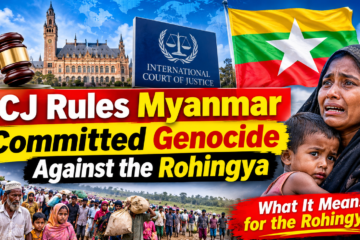
The Gambia took Myanmar to the ICJ in November 2019. On 19 November 2026, the judges ruled by nine votes to six that Myanmar committed genocide against the Rohingya in northern Rakhine State, the first time the court had found a state responsible for genocide, UN News reports.
The court put the number killed at an estimated 10,000 and found that nearly 400 villages were partly or fully destroyed. It ordered Myanmar to allow safe, voluntary and dignified return and to investigate and prosecute those responsible. Compensation will be settled later. Our full report on the ICJ ruling on genocide against the Rohingya walks through the findings and the enforcement problem.
Where the Rohingya are now
Reuters, citing the UN, counts more than 1.3 million Rohingya displaced across South and Southeast Asia, including 1.2 million in Cox’s Bazar, Bangladesh. According to UNRIC, they live in 33 camps that form the largest refugee settlement in the world. UNRIC also lists the island of Bhasan Char among the places where aid reaches refugees.
Conditions are hard. UNRIC says the monsoon, from June to October, brings floods and landslides, and poor water and sanitation raise the risk of hepatitis and dengue. Cyclone Mocha in 2023 hit more than 10 million people across Bangladesh and Myanmar, refugees included.
Money is short too. The 2025 appeal for the Rohingya response sought $934.5 million and received $491.8 million, just over half.
Some take the sea route out. According to UNHCR figures cited by UNRIC, 2025 was the deadliest year on record for crossings in the Andaman Sea and Bay of Bengal, with nearly 900 Rohingya dead or missing.
Rakhine itself is dangerous. Fighting between the military and the Arakan Army, a rebel group, has spread since November 2023, and Reuters reported that the Arakan Army set alight swathes of the Rohingya settlement of Buthidaung in May 2024. UNRIC counts about 150,000 new arrivals who fled renewed violence in Rakhine since early 2024.
Going home remains uncertain. Myanmar said in August 2026 it had verified 308,797 people in Bangladesh camps as former Rakhine residents, but that returns would start only once security improved, per Reuters. Aid groups say conditions for safe return do not exist, and repatriation plans in 2018 and 2019 produced no returns. Rohingya advocates also point to refugees in India, Malaysia, Thailand and Nepal who face mistreatment, arbitrary detention and fear of deportation, Al Jazeera reports.
Quick answers
Are all Rohingya Muslim?
Not all of them. Al Jazeera describes the Rohingya as an ethnic group, the majority of whom are Muslim.
How many Rohingya are there?
About 1.4 million lived in Myanmar before 2017. Now more than 1.3 million are displaced across South and Southeast Asia, including 1.2 million in Cox’s Bazar, and about 520,000 remain in Myanmar, according to Reuters and Al Jazeera.
Why does Myanmar avoid the word Rohingya?
The government does not recognise the group and says its members are illegal migrants from Bangladesh. Many Buddhists reject the name as a modern invention, while the Rohingya use it for themselves.
Why are they called the most persecuted minority?
Al Jazeera notes that the international community has labelled the Rohingya the most persecuted minority in the world, and that the UN, Amnesty International and Human Rights Watch have consistently decried their treatment. The label is a description. The court’s 2026 ruling is a legal finding about northern Rakhine in 2017.
Where to follow what happens next
Myanmar has two years from the November 2026 judgment to report on restitution measures and propose compensation. UNRIC’s Rohingya page was last updated in August 2026 and carries current figures, so check it for new numbers before you quote them.