
The Economist released The World Ahead 2027 on 17 November 2026, and its editor, Tom Standage, opened with one line: “The post-Trump era is beginning.” Ten themes follow, from French politics to Starship launches. Plenty of posts already decode the cover, but the press release is the better guide to Economist predictions 2027. This article takes each theme in turn, adds outside data, and marks where the evidence is thinner than the headlines.
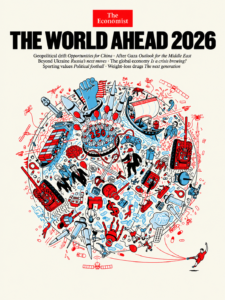
The World Ahead 2027 cover: real or fake?
Before launch, an AI-made image with a cake marked “2027” passed as the new cover. AAP FactCheck found it was AI-generated and that the magazine had not yet published the edition. The real cover arrived on 17 November in black, red and white with military and market imagery, according to Turkish outlet Haberler. Any reading of hidden symbols beyond that is guesswork.
The post-Trump era starts early
The first theme says the race to succeed Donald Trump begins in 2027 and that the world will start picturing a post-Trump America. Standage does not expect a quiet exit. With Democrats taking charge of both chambers of Congress, he expects more executive orders and legal fights, plus building projects and military adventures, as Trump tries to shape his legacy. The press release also says America’s allies no longer trust it and its enemies no longer fear it, which is the report’s version of a global power shift.
Iran’s aftershocks reach the farm gate
The Economist says the Iran war will reshape regional politics and redraw energy flows, while scarce fertilizer threatens food security. The mechanism is documented. The FAO says tanker traffic through the Strait of Hormuz fell by over 90 percent, and the strait normally carries about a quarter of global seaborne oil trade. By mid-April, urea prices were up 52 percent in the United States and 60 percent in Brazil.
A July WTO data blog adds a counterweight: urea had almost returned to pre-war levels after doubling. So the 2027 harvest risk depends on whether shipping stays open, and the evidence so far does not settle that.
Why 2027 could be the hottest year on record
The Economist expects another year of heat waves, with droughts and wildfires to match. The cause is already visible in the Pacific, where what the Economist calls a super El Niño is under way. On 12 November, NOAA’s Climate Prediction Center put the odds of a strong-to-very-strong El Niño lasting through January to March 2027 above 79 percent, with about 60 percent odds of an event stronger than any since 1950.
Heat lags the ocean. Met Office scientist Nick Dunstone says 2027 is very likely to replace 2024 as the warmest year on record, because the global effect peaks the year after El Niño’s winter high. NOAA expects neutral conditions to become more probable from April to June.
The Economist adds a political twist: Trump has unwittingly become renewable energy’s best salesman, since renewables shield countries from energy price swings.
The AI backlash and the debt behind it
The Economist says a crash becomes more likely as AI firms take on debt through complex, opaque deals. It considers the financial risk real, along with the political and cyber ones, and calls fears about jobs and the environment overstated.
The debt numbers support the first half. The Federal Reserve’s latest financial stability report, as reported by Axios, says companies borrowed more than $680 billion for data centers and advanced computing in the first ten months of 2026, about five times the 2023 total. Banks have close to $1 trillion of exposure.
Not everyone calls it a crisis. A Fortune analysis from 18 November says today falls short of a debt crisis, and the danger is financing assumptions breaking before returns arrive. That is a narrower claim than “bubble.”
Can Marine Le Pen win France?
The Economist’s big European question is whether French voters elect Marine Le Pen, which it says would jolt the EU and jam the Franco-German engine.
The legal route is open. On 7 July a Paris appeals court upheld her conviction for misusing EU funds but shortened her ban from office, so she can stand when voters go to the polls in April 2027. The ruling carries an electronic-bracelet condition she had previously ruled out, yet she went on to announce her candidacy on TF1.
Bond markets: where something gives
Behind France sits a wider claim. The Economist says many rich countries live beyond their means, yields are rising, and something will break. France is the clearest case.
Its 10-year yield briefly topped 5 percent on 21 October for the first time since 2002. The next day the gap over German bonds passed 170 basis points, a level last seen in the early 2010s debt crisis, and CNBC cites debt of 119 percent of GDP at the end of the second quarter.
Trading Economics put the yield at 4.87 percent on 18 November, below the October peak. That is a stress signal, not a recession forecast, and the Economist does not offer one.
Taiwan and the date everyone quotes
The Economist notes that Xi Jinping is said to have set 2027 as the year China’s forces should be ready to take Taiwan, and asks how drone-era warfare changes the picture, since smaller forces have held off larger ones in Ukraine and Iran. The Pentagon’s 2025 report says China “expects to be able to fight and win a war on Taiwan” by the end of 2027.
The US-China Economic and Security Review Commission adds caution. It calls 2027 a capability deadline, not necessarily an invasion date, and notes that the year marks the PLA’s 100th anniversary. Beijing has never publicly confirmed a deadline, and Xi reportedly denied invasion plans for 2027 when he met Joe Biden in 2023.
The Ozempic effect on shopping and aging
About one in five US households includes a current GLP-1 user as of May 2026, according to a PwC analysis of Numerator data. The Economist says the newly slim splurge on clothes and cosmetics as well as fitness, and that the drugs’ apparent anti-aging effects have revived pharma interest in longevity treatments.
PwC’s May survey of 3,089 consumers backs the clothing claim: 73 percent of current users reported a meaningful change in clothing size, and 26 percent were spending more on clothing. Fitness is mixed. Coverage of the same survey says 14 percent of users cut group classes while 11 percent added them.
Space gets cheaper, and stranger
The World Ahead 2027 expects Starship to begin regular satellite launches. It also expects the first private-sector space station to launch, and orbital data centers to sound less far-fetched.
Some of that has happened. Starship’s 14th flight on 28 September was its first to reach orbit, carrying 26 Starlink V3 satellites. Flight 15 on 13 November deployed 26 more, though the booster catch was aborted and the booster lost offshore.
Vast’s Haven-1 station targets the first quarter of 2027 on a Falcon 9, after slipping from 2026. The same company plans satellite buses with optional Nvidia modules for on-orbit data centers.
Rebooting Hollywood
Star Wars is the Economist’s example of a franchise courting new audiences while low-budget films by YouTubers do well. The original opened on 25 May 1977. Lucasfilm will re-release a restored version in IMAX on 19 February, and Star Wars: Starfighter opens on 28 May, per ABC Audio.
What will happen in 2027? Quick answers about The World Ahead 2027
Who writes it? Standage edits it, with guest authors such as Japan’s prime minister Takaichi Sanae, Finland’s president Alexander Stubb and UCLA’s Terence Tao.
How long has it run?
About 40 years, according to AAP.
Where can you read The World Ahead 2027?
The print issue is dated 21 November, the stand-alone edition reaches newsstands on 26 November, and the theme articles are on economist.com.
Dates worth putting in your calendar
Pick these: 19 February for Star Wars in IMAX, the first quarter for Haven-1, April for the French first round, and August for the PLA centenary. Check each against an official source as it nears, since Haven-1 has already slipped once.