
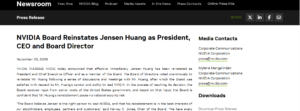
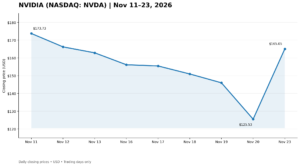
Jensen Huang is back as Nvidia CEO. The board voted unanimously on Monday, Nov. 23, 2026, to reinstate him as president, CEO and director, effective immediately, roughly 12 days after his resignation. The stock closed that day at $165.05, up 31.5%. What the rally can’t price yet is an open investigation, two congressional appearances and a board that said six days earlier it had no plan to bring him back.
How the 12 days unfolded
The trouble started before the resignation. In late October, the New York Times reported on a federal investigation into whether Singapore-based Megaspeed International had diverted advanced AI chips to China, and on Huang’s relationship with Alice Huang, a former Megaspeed executive. Nvidia denied wrongdoing. Huang then admitted the affair in a message to employees.
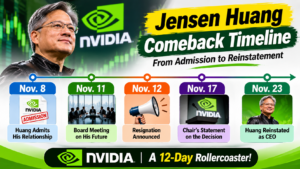
US officials were quoted as saying the woman had been recruited by China’s Ministry of State Security. China’s foreign ministry called that groundless speculation, and Attorney General Todd Blanche said the Justice Department hadn’t yet decided whether she was a spy. Nvidia’s board first backed Huang and opened an independent investigation into reports that he had been targeted by Chinese intelligence.
A second report, about a relationship with a company executive, arrived as the board met on Wednesday, Nov. 11. Al Jazeera reported that the resignation was announced the next morning, and CFO Colette Kress took over as interim CEO.
Then the direction reversed. Axios reported that board chair Harvey Jones had said just six days before the vote that Nvidia didn’t intend to reinstate him. Meanwhile a “Stand With Jensen” petition gathered more than 100,000 signatures, Elon Musk’s among them.
Why one executive moved the whole market
A resignation at most companies is a personnel story. This one hit index levels. Axios wrote that Huang’s exit pushed the stock market into correction territory, and that his return set off a large early rally.
Boston College’s Aleksandar Tomic told Al Jazeera that the loss of Huang would have an outsized effect given Nvidia’s relatively flat structure, though he called it a speed bump for the company. Those two views sit together awkwardly. If the effect was outsized, the bump was a steep one, and the market’s first week without him suggests as much.
Why the board changed its mind
The company’s stated reasons are short. After a series of meetings, the board said it was satisfied with Huang’s candor and ability to lead, and that it had received input from senior levels of the US government. Based on that input, it said his return poses no national security risk. Jones added that “the Board believes Jensen is the right person to lead NVIDIA.”
The political backdrop is less tidy. President Trump had urged the board repeatedly to take Huang back. Asked about a Semafor report that he called into a board meeting, he told reporters, per NPR, “I was represented at the board.” Axios noted that Treasury Secretary Scott Bessent had first called for an outside CEO and a “dramatic shakeup” before softening his stance the day before the vote.
Markets also mattered. Hedgeye’s Felix Wang told the South China Morning Post that the recent stock market turmoil was likely a reason Trump pushed for the reinstatement. That’s one analyst’s read, and the board’s own statement doesn’t mention the share price.
Twelve days, five days, twelve years
Yahoo Finance’s headline compares Huang’s absence with two famous boomerangs. The comparison holds up better when you check what each clock measured.
| Executive | Out | Back | Gap |
|---|---|---|---|
| Sam Altman, OpenAI | Nov. 17, 2023 | Deal Nov. 21, formal Nov. 29, 2023 | About 5 days to a deal, 12 days to finalize |
| Jensen Huang, Nvidia | Nov. 11, 2026 (announced Nov. 12) | Nov. 23, 2026 | 12 days |
| Steve Jobs, Apple | Sept. 1985 | Sept. 1997 (interim CEO) | 12 years |
Altman’s agreement in principle came late on a Tuesday, and OpenAI published the finished arrangement on Nov. 29. Counted that way, his return also took about 12 days. The Jobs dates come from Yahoo Finance.
One difference matters more than the arithmetic. Altman came back to a new board. Huang came back to the same chair, with a new national security committee and an unfinished investigation attached.
What the stock did, and what research says about boomerangs
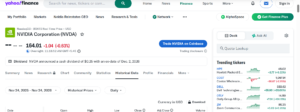
The Nov. 23 rally was large by any measure. The Dow, S&P 500 and Nasdaq all had their best day since April 2025. Yahoo Finance’s chart put Nvidia’s value at about $4.2 trillion on the Nov. 11 close and about $3.0 trillion by Nov. 20, a loss near $1.2 trillion, during what it called the stock’s worst week ever. Other outlets cited different totals at different moments, so treat any single figure as a snapshot.
First-day pops don’t predict much. Yahoo’s tally of seven famous CEO returns found five stocks rose on day one, led by Starbucks at 8%, while Under Armour fell 11% in 2024. Only three beat the S&P 500 over the following year. Apple’s 1997 comeback beat it by 65 percentage points.
The academic evidence is less friendly. A study of 167 returning CEOs at S&P 1500 companies from 1992 to 2017 found their stocks trailed first-time CEOs by 10.1% a year, and the gap was wider in fast-changing industries. Founders made up 4% of all CEOs in the sample but 44% of the boomerangs.
Two caveats apply. The sample ends in 2017, so it says nothing about an AI chipmaker, and the study found some founders did especially well. The study’s central explanation is that returning CEOs find a company they barely recognize. Huang was gone less than two weeks, so that explanation fits his case poorly.
What hasn’t been settled
The board said its committee of independent directors will finish its investigation into whether Huang was the target of a foreign intelligence effort, and that he supports it. Nvidia also formed a National Security and Export Control Committee of independent directors and is searching for a chief compliance officer who will report to the nominating and corporate governance committee.
The China question sits underneath all of this. Al Jazeera noted that Huang, 63, had spent years campaigning against restrictions on Nvidia chip sales to China. Against that background, the board’s written statement that it had weighed input from the US government reads as a response to a policy problem, not only a personal one.
Washington isn’t finished either. House committees have asked Huang for a closed-door interview on Dec. 1, and he is scheduled to testify publicly before the Senate Banking Committee on Dec. 3, BigGo Finance reported. Senator Elizabeth Warren called the reinstatement reckless. A House Intelligence Committee spokesperson said it changes nothing about the inquiry, according to CNBC’s roundup of open questions.
Quick answers
Who ran Nvidia while Huang was out? Colette Kress, who served as interim CEO while keeping her CFO duties, according to Nvidia’s announcement.
Did the board vote split? No. The vote was unanimous, per the company’s 8-K filing.
Is the matter closed? The job question is, for now. The investigation and the hearings aren’t.
How to follow this story from primary sources
Most coverage repeats the same few documents. Reading them yourself takes about ten minutes.
- Open Nvidia’s reinstatement announcement and note the exact wording on the board’s reasons.
- Open the matching SEC filing (Form 8-K) and compare the two texts. The filing is the legal record.
- Treat any claim about who influenced the decision as unconfirmed unless it appears in one of those two documents. The Trump quote above comes from a press exchange, not from Nvidia.
- Mark Dec. 1 and Dec. 3 in your calendar, then read what Huang says under questioning before drawing conclusions about the investigation.
If you only do one thing, do step 4. The first three show what Nvidia wants known, and the hearings show what Congress still wants answered.